GLM 5.2 vs Kimi K2.7 Code vs Opus 4.8: we ran it.
Two open-weight models against a frontier closed one. We put all three through 12 tasks — half coding, half reasoning — with identical prompts and parameters. Coding answers were graded by running the code against hidden tests; reasoning by exact match. GLM 5.2 is the one you can run on HYRE; the other two we called on the same upstream to see how it stacks up.
3 × 12/12
every model solved every task — correctness was a wash
5.7×
Opus 4.8's cost over the cheapest model, for identical answers
−50%
GLM 5.2 on HYRE — half-price through Jul 19, the only one you can buy here
The result: everyone aced it
All three models solved all 12 tasks — 6/6 coding and 6/6 reasoning, every program passing its hidden tests, every answer exact. On tasks this size, the frontier model bought no extra correctness. The spread is entirely in cost and verbosity.
GLM 5.2
12/12
coding 6/6 · reasoning 6/6
Kimi K2.7 Code
12/12
coding 6/6 · reasoning 6/6
Opus 4.8
12/12
coding 6/6 · reasoning 6/6
Where they split: speed, tokens, cost
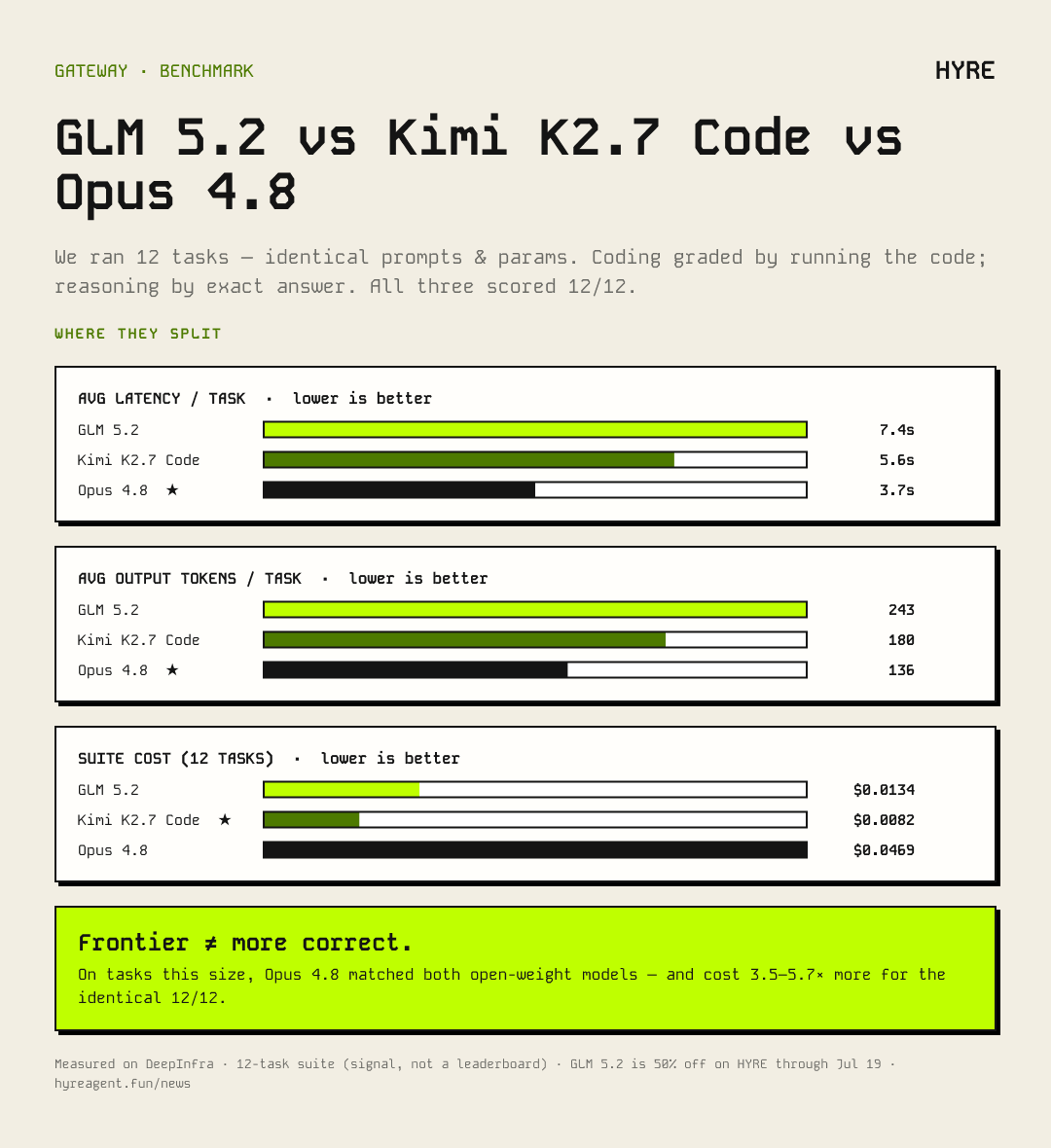
Same answers, very different effort and price. ★ marks the best (lowest) in each row.
Avg latency / task · lower is better
Avg output tokens / task · lower is better
Cost — full 12-task suite · lower is better
Suite cost is the real DeepInfra charge for all 12 calls per model. Opus 4.8 was leanest and fastest this run — and still cost 3.5× GLM 5.2 and 5.7× Kimi, because its per-token rate is 6–7× higher.
Latency, task by task
Bars to scale (GLM / Kimi / Opus, top to bottom per task); seconds at right. Latency swings run to run on shared infra — read the shape, not the decimals.
Reading the numbers
- The frontier model didn't buy correctness here. Opus 4.8 matched two open-weight models task-for-task — and cost 3.5× GLM 5.2 and 5.7× Kimi K2.7 Code for the identical 12/12. Its premium is a bet on harder problems this suite doesn't test.
- Kimi K2.7 Code is the value champion. Cheapest suite ($0.008), leanest of the open pair (180 tokens avg), and coding-tuned — the best raw price/perf if you just want correct code out.
- GLM 5.2 sits in the middle — and it's the one on HYRE. A touch more verbose, but it matched both on correctness, carries a 1M context, and on HYRE it's 50% off through Jul 19 (cheaper than its list) with 1,000 free calls/week for 5M $HYRE holders.
- Latency is noisy.Opus led this run, but per-task swings (and GLM's slower reasoning tasks today) are shared-infra variance. Cost and token counts are the metrics that hold up.
The spec context
| SPEC | GLM 5.2 | KIMI K2.7 CODE | OPUS 4.8 |
|---|---|---|---|
| Provider | Z.ai (Zhipu) | Moonshot AI | Anthropic |
| On HYRE? | Yes — 50% off → Jul 19 | No | No |
| Context window | 1M | 256K | 1M |
| Input / 1M (DeepInfra) | $1.20 | $0.74 | $5.00 |
| Output / 1M (DeepInfra) | $4.20 | $3.50 | $25.00 |
| Weights | Open (fp4) | Open (fp4) | Closed |
How to choose
GLM 5.2
- • Matched Opus on correctness; open-weight; 1M context.
- • On HYRE today: 50% off + 1,000 free/wk for 5M holders.
KIMI K2.7 CODE
- • Cheapest + leanest of the three; coding-tuned.
- • Best raw price/perf when you just need correct code.
OPUS 4.8
- • Frontier headroom for hard, ambiguous, long-horizon work.
- • Pay 3.5–5.7× more — worth it only past where this suite stops.
Run it yourself
GLM 5.2 is one line away on HYRE's OpenAI-compatible endpoint. Don't trust our 12 tasks — point your own prompts at it:
curl https://gw.hyreagent.fun/api/inference/v1/chat/completions \
  -H "Authorization: Bearer $HYRE_GW_KEY" \
  -d '{"model": "zai-org/GLM-5.2", "messages": [...]}'
Methodology
- 12 tasks: 6 coding (Two Sum, valid parentheses, merge intervals, Roman→int, longest unique substring, coin change) and 6 reasoning (transitive ordering, train speed, digit counting, day-of-week mod, dice probability, reverse-discount).
- Identical for all three models: same system + user prompt, temperature 0.2, top_p 1, max_tokens 8192, non-streaming. Called directly on DeepInfra (the gateway's upstream).
- Coding scored objectively: each model's generated Python is executed against hidden asserts — pass means the code actually runs correctly, not that it looks right. Reasoning scored by exact match on a parsed ANSWER line.
- Every call finished cleanly (finish_reason = stop) — no truncation. Total real spend for the run: $0.069.
- Serving note: GLM 5.2 and Kimi K2.7 Code run fp4-quantized on DeepInfra; Opus 4.8 is the closed Anthropic model. So this compares them as actually served, not necessarily full-precision open weights.
- Caveats: a 12-task suite is a signal, not a leaderboard. Single run at temperature 0.2; latency is noisy on shared infra (token efficiency and cost are the steadier metrics). Standard algorithmic + known-answer tasks don't probe large-codebase, long-horizon, ambiguous, or tool-use quality — exactly where a frontier model may earn its premium.